Variable Star: A Futuristic Display Font for Creative Makers
I spread the matte black candle label across my light pad and let my eyes adjust to the lettering. The word “Nova” sat in the centre, shaped from Variable Star, and it genuinely looked like it was drifting through quiet space. The thin thins, the rounded alternates, and the way the crossbars seemed to hover — this was not another rustic serif or a dainty calligraphy script. This was something built for makers who want their products to whisper a little stardust. Whether you sell candles, printable wall art, wedding invitations, or branded boutique tags, Variable Star brings a gentle sci-fi warmth that feels both handmade and futuristic at the same time.
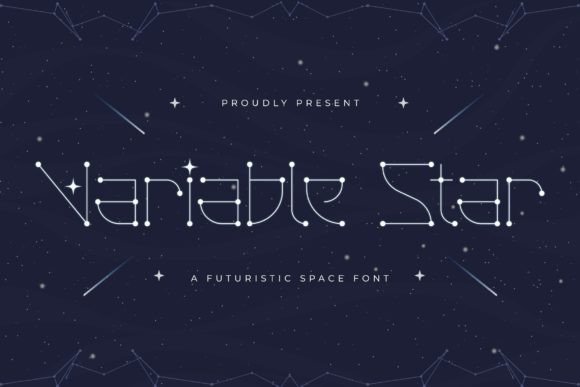
Variable Star is a decorative display font with a light, airy personality. Its letters don’t shout; they float. The terminals curve like crescent moons, and certain uppercase characters carry a subtle inline cut that catches the eye without overwhelming a label. When I tested it against a deep navy background with silver foil liner, the text looked like a constellation carved into the wax itself. That exact moment — watching a typeface turn an everyday candle jar into a cosmic experience — sold me on using it for more than just one project. It’s become my go-to display font for anything that needs a clean, optimistic space-age feel.
Lighting Up a Candle Label with Variable Star
I print my own candle labels at home using a laser printer and adhesive matte paper. Detail matters because the label is the first thing a customer touches. With Variable Star, I noticed that a single short word — like “Luna,” “Orbit,” or “Echo” — gains a story. The font’s gentle letter spacing keeps each character readable even when scaled down to 18pt on a 2-inch round sticker. I set the product name in Variable Star, then pair it with a simple sans serif for the scent description and weight. The result is a label that feels premium, intentional, and very hard to scroll past in a shop feed.
For candle makers, Variable Star can be the signature ingredient on your packaging. It works beautifully on cylindrical jars, flat-lay mockups, and transparent sleeve labels. Because the letterforms are clean but playful, they reflect light well in photos, especially when printed in metallic gold or holographic toner. That’s a plus for anyone staging product shots with fairy lights, dark backgrounds, or moon-phase props.
From Stickers to Wedding Signage: Finding the Perfect Project
What surprised me most was how naturally Variable Star moved between small-scale crafts and large-format pieces. I tested it on a welcome sign for a friend’s bridal shower. The phrase “To the Moon & Back” was cut from adhesive vinyl on my Silhouette, and despite the delicate lines, the font weeded cleanly with no broken stems. The upright, streamlined structure meant I didn’t need to over-weld or reinforce thin connectors. On a mirror sign, it held its own next to eucalyptus garlands and tiny fairy lights.
For sticker sheets and planner decals, Variable Star adds a unique category: dreamy space icons with a modern edge. I designed a sheet of small circular stickers with words like “launch,” “dream,” “roam,” and “rise.” Set in Variable Star, they looked like tokens from a friendly space station. The font gives off the kind of energy that works perfectly for kids’ reward charts, sci-fi birthday party favours, or a weekly habit tracker that feels more like a mission control log than a chore list.
Greeting cards and invitation suites are another natural home. A simple “You’re Out of This World” card with Variable Star centred on a black background and a single silver star icon was one of my quickest and most-pinned card designs. The typeface does the heavy lifting. It communicates whimsy and sincerity without the need for extra illustration. For a wedding invitation, it can elegantly hold the couple’s names while a clean serif carries the body text. The contrast between the futuristic display and a classic serif creates an immediate editorial feel that appeals to stationery designers looking for something beyond traditional calligraphy.
The Magic of Display Typography on Physical Products
As a maker, I care deeply about how a font feels in the hand — not just on screen. Variable Star has that rare quality of making a physical product feel like a limited-edition find. When I added it to hang tags for small-batch sewn pouches, the crisp, rounded geometry gave the tags an aerospace-meets-handcrafted vibe. I kept the colour palette minimal: black ink on kraft paper, with the product name in Variable Star and the care instructions in a lightweight sans serif. The tags took only minutes to thread onto the drawstring bags, but the perceived value of the set jumped instantly.
Even on textiles, the font translates well. I created a simple tote bag design that read “Cosmic Wanderer” in white vinyl. Heat-pressed onto navy canvas, the text retained its delicate lines while staying firmly attached after multiple washes. The secret was size — I kept the lettering at least 2.5 inches tall and avoided overly thin stroke sections. That same design worked on a unisex tee shirt, with the phrase arching lightly across the chest. It was bold enough to be seen from a distance, yet soft enough that it didn’t feel like a loud graphic tee.
Printable wall art is another area where Variable Star sings. I set a large “Stardust” print in the font, added subtle star sparkles, and offered it as a digital download in three sizes. The variable upright style makes it suitable for a nursery, a teen bedroom, or a home office gallery wall. Because the download is instant, customers can print it at home or send it to a local print shop. I made sure to include a note about print settings so the fine details wouldn’t fill in on porous paper — a small gesture that shows buyers you’ve thought about their finished product.
Making Variable Star Readable on Small Surfaces
Any crafter who works with tiny text knows the pain of choosing a beautiful typeface only to have it close up on a 1-inch button or a slim product label. Variable Star is first and foremost a display font, so it’s happiest at larger sizes or in very short phrases. I recommend using it for names, titles, and hero words, never for paragraphs of product information. On small stickers, I stay above 14pt and increase the letter spacing just slightly if the stickers are glossy, as gloss can cause fine lines to disappear under certain lighting.
For cutting machines like Cricut and Silhouette, the font cuts beautifully when sized appropriately. The thin strokes are more delicate than a chunky sans serif, so a sharp blade and a light grip mat are your best friends. I did a test run with glitter cardstock, and the letters lifted perfectly after a quick pass with a weeding tool. On standard adhesive vinyl, I had no tearing as long as I didn’t rush the peel. If you plan to use Variable Star for very small text — under half an inch — on a shirt or a mug decal, consider thickening the stroke slightly in your design software, or choose a bolder weight if the font family includes one. Some versions come with variable weight options or stylistic alternates that can beef up certain letters without losing the space-age character.
A Simple Pairing Strategy for a Cohesive Brand
Variable Star does its best work when given room to breathe. I like to pair it with a clean, neutral sans serif like a geometric grotesk or a humanist sans. This keeps the main message dreamy and futuristic while the secondary text remains highly readable. For any product label, I set the scent or flavour name in Variable Star, then use the sans serif for the net weight, ingredients, and social handle. The combination looks balanced and intentional, never cluttered.
If you’re designing wedding stationery, pair the font with a delicate script font for the couple’s initials or a short quote. The juxtaposition of space-forward display and romantic calligraphy creates a mood that’s simultaneously modern and timeless. For a farmhouse sign or a boutique shelf tag, a warm serif font underneath adds that grounded, heritage feel that contrasts beautifully with the celestial top line. Just avoid pairing Variable Star with another highly decorative font, as the two can compete and muddy the focal point. One star per design, literally.
When preparing listing images for online marketplaces, Variable Star helps product photos look cohesive. I use it sparingly — maybe the product name at the top or a small badge element — and keep the rest of the overlay text in a supplementary typeface. This builds instant brand recognition without the typography overwhelming the actual product. A consistent type palette can be one of your most valuable design assets as a small shop owner, and adding a distinctive display face like this one quietly elevates everything from social media graphics to thank-you cards.
Preparing Variable Star for Commercial Use and Print
Before setting your labels, stickers, or digital downloads live, take a few minutes to explore everything the font family offers. Variable Star may include alternate glyphs, ligatures, or swashes that can completely change a word’s look. In my candle label project, I swapped a standard ‘a’ for a rounded alternate, and that tiny tweak made the entire layout feel more custom. Open the glyph panel in your design software and scroll through the options — you might discover a capital ‘S’ with a starburst flourish or a lowercase ‘g’ that loops like a planetary orbit.
File formats matter. For physical product design, OTF and TTF are both widely supported and work seamlessly in Adobe Illustrator, Photoshop, Silhouette Studio, Cricut Design Space, and other popular software. If you’re creating printables or digital template previews, make sure you have the proper commercial license to sell designs that include the font in flattened or outlined forms. Many smaller foundries offer a one-time commercial font license that covers physical goods and digital downloads, but always double-check the EULA, especially for print-on-demand items or SVG-style cut files distributed to customers. Respecting licensing not only protects your business but also supports the type designers who create the tools we love.
Multilingual support is another detail to confirm. If you sell in multiple countries or design for an international client base, check that Variable Star includes the accented characters, punctuation, and special glyphs you need. A quick test with words like “voilà,” “año,” or “für” will tell you everything. When a font supports your language natively, you avoid awkward letter substitutions that can make an otherwise polished product look unprofessional.
Every time I open a fresh jar, label sheet, or blank canvas, Variable Star reminds me that typography can do more than just carry words — it can set a mood, define a brand, and make a handmade product feel like it belongs in someone’s favourite corner of their home. Whether you’re designing a single birthday invitation or building an entire line of cosmic-themed stationery, this creative font brings a quiet wonder that turns ordinary materials into something a little closer to the stars.